
Walk into almost any gym and you’ll hear the same advice: “Just keep adding weight.”
While increasing load is one way to create progress, it’s far from the only one—and often not the best one.
If adding weight were the only way to improve, every experienced lifter would continue getting stronger forever.
That isn’t how the body works.
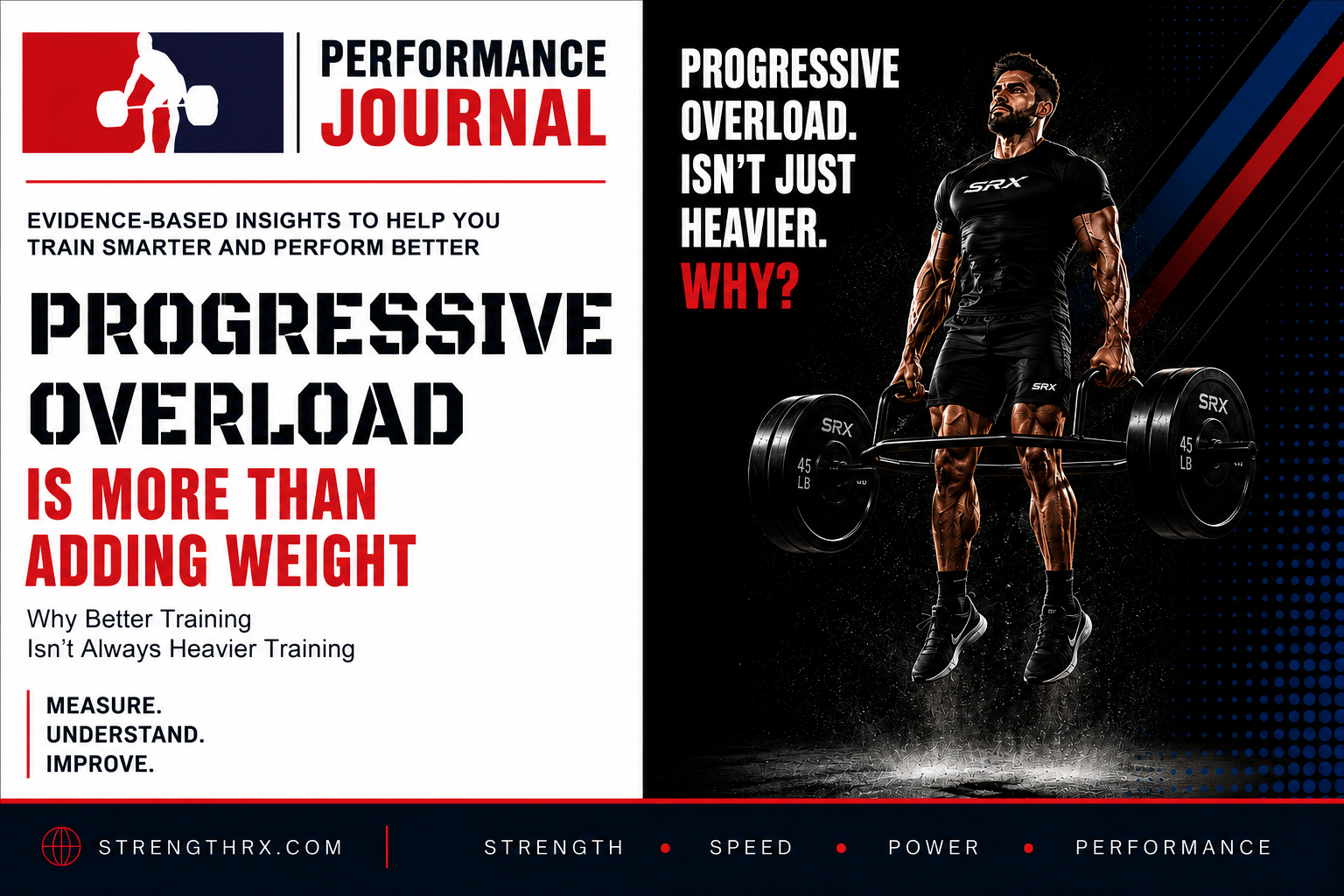
Progressive overload isn’t about making every workout heavier. It’s about providing a training stimulus that gives your body a reason to adapt. Sometimes that stimulus is more weight. Other times it’s better movement, greater force production, increased speed, improved control, or higher-quality work.
Understanding that difference is what separates purposeful training from simply working hard.
The Body Adapts to Stress—Not Just Weight
Your body doesn’t recognize a number on a barbell.
It recognizes stress.
That stress can come from:
- Increasing load
- Producing force more quickly
- Moving through a greater controlled range of motion
- Performing more quality work
- Improving movement efficiency
- Increasing training density
- Reducing compensation during movement
The goal isn’t simply making an exercise harder.
The goal is giving your body a reason to adapt.
That’s progressive overload.
More Weight Isn’t Always Better
The goal is better adaptation—not simply heavier lifting.
Adding weight too early often changes the exercise instead of improving the athlete.
Depth decreases.
Technique breaks down.
Momentum replaces control.
Compensations appear.
The movement may become heavier, but it doesn’t necessarily become better.
Progressive overload only works when the quality of movement remains high enough to produce the adaptation you’re actually seeking.
Sometimes the best progression is five more pounds.
Sometimes it’s performing the same weight with better mechanics.
Sometimes it’s producing more force with the same load.
Sometimes it’s moving the same load faster.
The body responds to all of those challenges.
Overload Can Take Many Forms
Progressive overload is far broader than simply increasing resistance.
You can overload the body by improving:
- Strength
- Power
- Rate of Force Development
- Stability
- Coordination
- Work capacity
- Movement efficiency
- Range of motion under control
Different stress creates different adaptation.
That’s why effective programming begins with knowing what quality you’re trying to improve.
Measure More Than the Weight
The easiest thing to measure is the weight on the bar.
Unfortunately, it isn’t always the most important.
At Strength Rx, we look at how force is produced—not simply how much weight is lifted.
Depending on the athlete and the goal, meaningful progress may include:
- Better movement quality
- Greater force production
- Faster force production
- Improved power
- Better symmetry
- More efficient mechanics
- Greater confidence during movement
Sometimes the biggest improvement isn’t visible on the plates.
It’s visible in how the body performs.
Specificity Still Matters
Not every overload creates the same result.
If your goal is maximum strength, your overload strategy will differ from someone training for speed.
If your goal is improving clubhead speed, simply lifting heavier won’t necessarily transfer to faster swings.
If your goal is returning to running after injury, building confidence, coordination, and movement quality may be more valuable than increasing load.
The body always adapts specifically to the demands placed upon it.
That’s why progressive overload should always follow the Principle of Specificity—not replace it.
Train the Adaptation You Want
Progressive overload isn’t about proving you’re stronger every workout.
It’s about building the physical qualities that matter most for your goal.
That may mean adding weight.
It may mean improving movement quality.
It may mean producing force faster.
It may mean developing greater control throughout a larger range of motion.
When training is guided by objective measurement and purposeful progression, overload becomes far more than simply chasing heavier lifts.
It becomes a system for continual improvement.
Objective Performance. Measurable Results.
Performance isn’t built by simply adding weight. It’s built by applying the right training stimulus at the right time for the right adaptation. At Strength Rx, every program begins by identifying the physical qualities that matter most to your goals, then measuring progress objectively rather than relying on assumptions.
Alongside Strength Rx’s individualized coaching, Kinetic Torque™ uses the 1080 Motion platform to objectively measure force production, Rate of Force Development, power, speed, acceleration, deceleration, and movement efficiency in both linear and rotational performance.
Alongside Strength Rx’s individualized coaching, Kinetic Torque™ uses the 1080 Motion platform to objectively measure and develop force production, rate of force development, speed, power, acceleration, deceleration, and movement efficiency in both linear and rotational performance.