
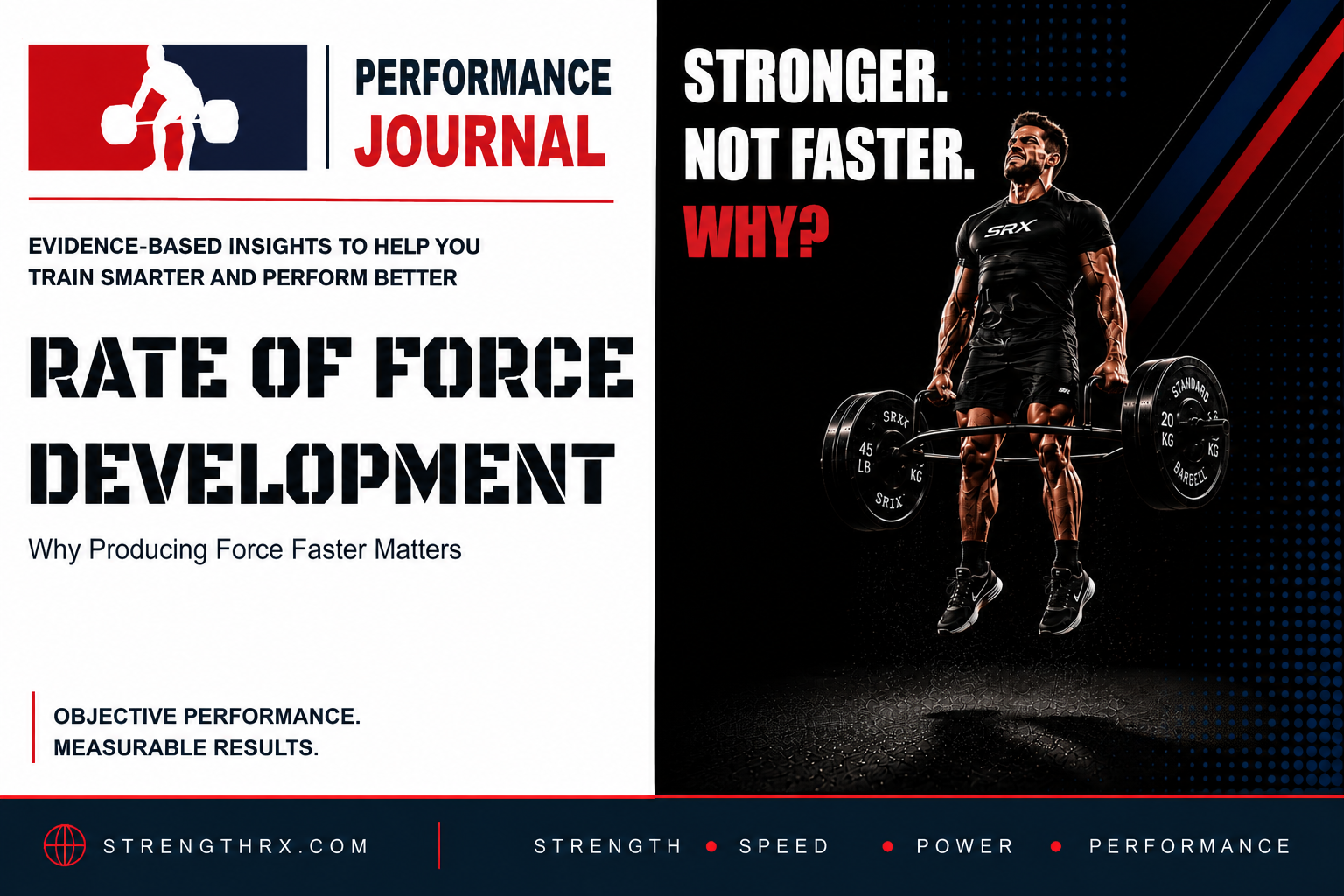
Strength matters.
But in sport—and in many everyday movements—it’s often not how much force you can produce.
It’s how quickly you can produce it.
This quality is known as Rate of Force Development (RFD), and it’s one of the biggest differences between simply becoming stronger and becoming more explosive.
A stronger athlete isn’t always the fastest athlete.
A stronger golfer doesn’t always swing faster.
A stronger older adult doesn’t always recover balance more effectively after a stumble.
The ability to generate force rapidly often determines performance.
Maximum Strength Takes Time
Imagine pushing against an immovable object.
If given enough time, you can gradually build force until you reach your maximum strength.
The problem is that sport rarely gives you enough time.
Most athletic movements occur in fractions of a second.
Ground contact during sprinting often lasts less than 0.20 seconds.
The downswing occurs so quickly that producing force rapidly matters more than producing force eventually.
Jumping, cutting, throwing, and changing direction all happen long before your body can express maximum strength.
If you can’t produce force quickly, your maximum strength may never be fully utilized.
Why Faster Force Wins
Think of force like money.
Maximum strength is how much money you have in the bank.
Rate of Force Development is how quickly you can access it.
Having a million dollars doesn’t help if you can only withdraw ten dollars per day.
Likewise, tremendous strength doesn’t guarantee explosive performance if you cannot access that force quickly enough.
Athletes who develop force earlier in a movement accelerate sooner, move more efficiently, and often outperform stronger athletes who generate force too slowly.
RFD Is Built on Strength
Rate of Force Development isn’t separate from strength.
It’s built upon it.
The stronger your foundation becomes, the greater your potential for producing force rapidly.
But strength alone isn’t enough.
Training must also teach your nervous system to recruit muscle quickly, coordinate movement efficiently, and apply force with intent.
That’s why developing explosive performance requires more than simply adding weight to the bar.
The Nervous System Drives Speed
Every explosive movement begins before your muscles produce force.
Your nervous system determines:
- How quickly muscles are recruited.
- How many motor units become active.
- How well muscles coordinate together.
- How efficiently force transfers through the body.
The faster your nervous system organizes movement, the faster force reaches the ground, the club, the ball, or your next step.
Explosive movement is as much neurological as it is muscular.
Where Rate of Force Development Matters
Nearly every athletic movement rewards rapid force production.
Sprinting
Acceleration depends on producing large amounts of force in very little time.
Every step is an opportunity to create propulsion.
The athlete who develops force sooner often accelerates faster.
Jumping
Vertical jumps aren’t won by strength alone.
They’re won by how rapidly force can be applied against the ground.
Golf
Clubhead speed depends on transferring force efficiently through the body.
Rotational sequencing, timing, and rapid force production all contribute to swing speed.
Change of Direction
Cutting, decelerating, and re-accelerating all require force to be produced immediately.
Delayed force production often results in slower movement and reduced efficiency.
Training for Faster Force
Improving Rate of Force Development doesn’t always require moving heavier weights.
It often requires moving with greater intent.
Training may include:
- Explosive strength work.
- Medicine ball throws.
- Jump training.
- Sprint development.
- Olympic lift variations.
- Velocity-based training.
- Rotational power development.
Each develops the ability to apply force more rapidly while maintaining movement quality.
Why Measuring Matters
Because Rate of Force Development happens so quickly, it’s difficult to evaluate by observation alone.
Objective data provides a clearer picture of how an athlete is improving.
Instead of relying on appearance, coaches can evaluate qualities such as:
- Force production
- Rate of force development
- Peak power
- Velocity
- Acceleration
- Deceleration
- Movement symmetry
These measurements help guide training decisions and monitor progress over time.
The Bottom Line
Strength creates potential.
Rate of Force Development determines how much of that potential you can actually use when time is limited.
The strongest athlete isn’t always the fastest.
The strongest golfer doesn’t always swing the hardest.
The strongest individual doesn’t always move the best.
In sport, the athlete who produces usable force first usually has the advantage.
Objective Performance. Measurable Results.
Improving Rate of Force Development isn’t about producing more force—it’s about producing force faster. Developing that ability requires purposeful training, progressive overload, and objective measurement so improvements can be tracked over time.
Alongside Strength Rx’s individualized coaching, Kinetic Torque™ uses the 1080 Motion platform to objectively measure and develop force production, rate of force development, speed, power, acceleration, deceleration, and movement efficiency in both linear and rotational performance.