
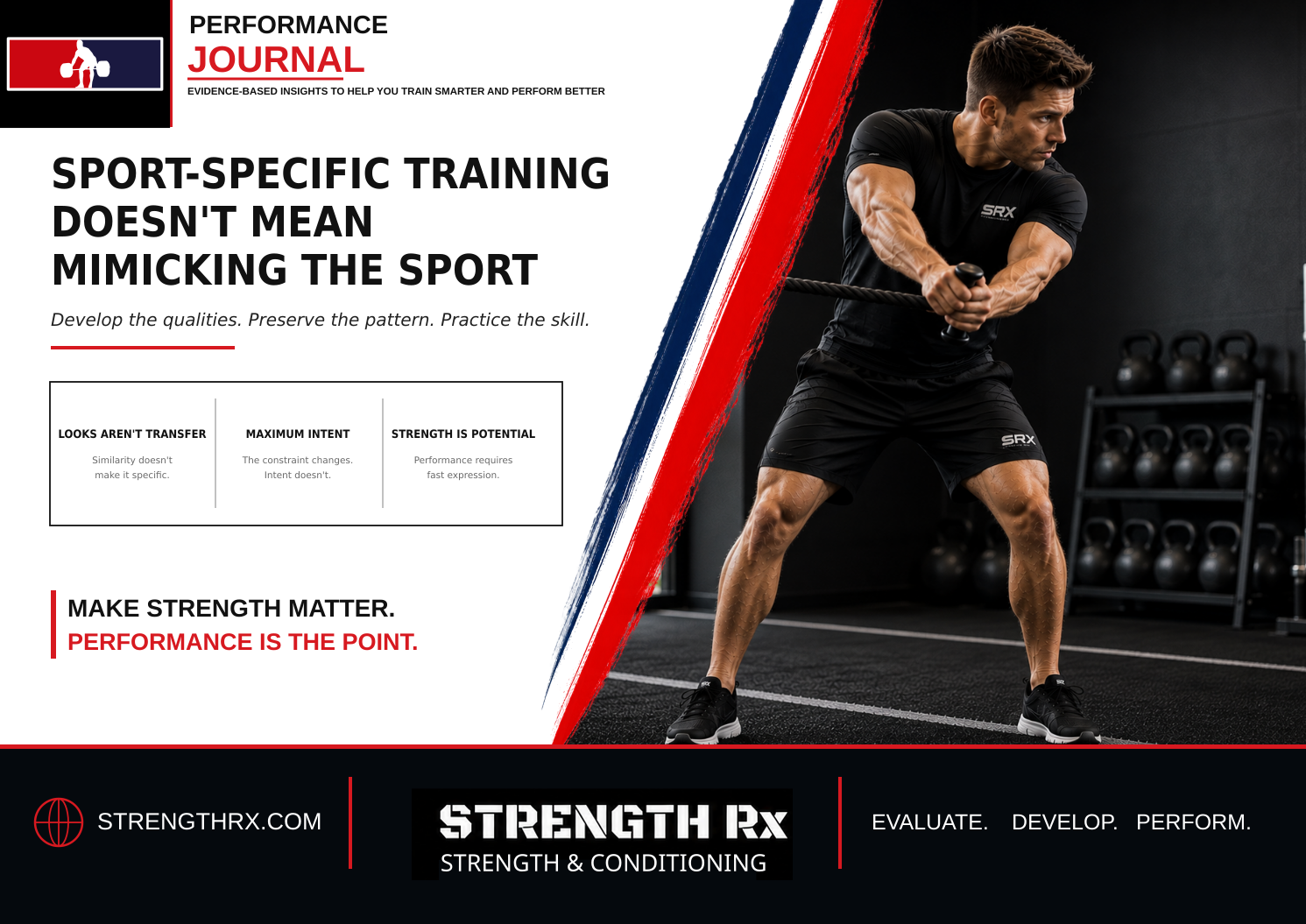
Why Developing the Right Physical Qualities Matters More Than Making an Exercise Look Familiar
“Sport-specific” is one of the most commonly used terms in performance training.
It is also one of the most misunderstood.
An exercise is often called sport-specific simply because it looks like something an athlete does during competition. A golfer performs a resisted rotation that resembles a golf swing. A baseball player swings against resistance. A hockey player performs a loaded movement that resembles a shot. A tennis player performs a cable movement that resembles a forehand.
The exercise looks like the sport, so it must transfer to the sport.
But visual similarity alone does not determine transfer.
The more important question is:
What physical quality are we trying to develop?
That question should determine the exercise, resistance, velocity, intent and progression—not whether the movement simply looks familiar.
The Weight Room Doesn’t Need to Reproduce the Sport
Sport skill and physical preparation are related, but they are not the same thing.
A golfer develops the skill of swinging a golf club by practicing the golf swing.
A baseball or softball player develops hitting skill by hitting.
A tennis or pickleball player develops stroke mechanics by practicing with a racquet.
A hockey player develops shooting mechanics by shooting a puck.
Performance training has a different job.
Its purpose is to develop physical qualities that give the athlete greater capacity to perform those skills—strength, force production, Rate of Force Development, power, velocity, stability, coordination and the ability to transfer force through the body.
Trying to make every exercise look exactly like the sport can miss that distinction.
An exercise may resemble the sporting movement but provide little meaningful stimulus for the physical quality we are trying to improve. In other cases, added resistance may alter the movement so much that the athlete is no longer using the sequence or positions we intended to train.
The weight room doesn’t need to reproduce the sport. It needs to prepare the athlete for its demands.
Looking Like the Sport Doesn’t Make an Exercise Sport-Specific
Consider a golfer performing a rotational exercise.
Because the athlete is rotating, the exercise may appear more “golf-specific” than a squat, deadlift, jump or other general strength exercise.
But appearance tells us very little about the actual training stimulus.
How much force is the athlete producing?
How quickly are they attempting to produce it?
How much time do they have to apply force?
What velocity are they reaching?
How much power are they producing?
Does the athlete maintain an appropriate rotational sequence?
And most importantly:
What adaptation are we trying to create?
Without answering those questions, calling an exercise sport-specific doesn’t tell us much.
At the same time, this doesn’t mean rotational exercises that resemble aspects of a sporting movement are inappropriate.
Quite the opposite.
When the movement is selected and progressed for a specific reason, it can give us an opportunity to develop physical qualities within a pattern that has relevance to the athlete.
The difference is that the resemblance isn’t the reason for the exercise. The intended adaptation is.
Similar Movement. Different Training Objective.
A rotational movement can be used to create very different training demands.
This is where the distinction between mimicking a sport and training for a sport becomes important.
Take a rotational exercise used with a golfer.
Early in the training process, we may want to place a greater emphasis on force production. Later, we may want the athlete to express that force at progressively higher velocities. Eventually, the emphasis may move toward high-velocity power, Rate of Force Development and speed.
The general rotational pattern does not necessarily need to change dramatically as we move through those objectives.
The stimulus does.
Traditionally, that might be accomplished by changing external resistance.
But resistance is not the only variable we can manipulate.
Changing the Constraint Without Changing the Load
The 1080 Quantum gives us another way to progress this type of training.
Instead of continually changing the external load, we can manipulate the speed at which the rope is allowed to travel.
That creates an interesting possibility:
The same rotational exercise can be performed with the same load throughout an extended training progression while the velocity constraint changes.
Early in the progression, rope speed can be restricted.
The athlete is still instructed to attack the movement with high intent. We are not asking the athlete to intentionally rotate slowly.
The Quantum limits how quickly the rope can travel.
That braking action creates substantially greater tension, even when the external load itself is relatively light. The athlete attempts to accelerate aggressively but has to produce force against the imposed velocity constraint.
At this stage, the movement may be relatively slow.
But slow movement does not mean low intent.
That distinction matters.
The athlete is attempting to move rapidly. The equipment is creating the constraint.
Maximum Intent. Changing Constraint.
As the athlete progresses, we can gradually increase the permitted rope speed.
The external load can remain the same.
The exercise can remain the same.
The athlete’s intent can remain the same.
What changes is the amount of braking imposed on the movement.
As the permitted rope speed increases, the athlete is allowed to express force at progressively greater velocities.
The emphasis begins shifting.
Greater velocity means less time to produce force. The athlete increasingly has to express the force capacity developed earlier within shorter time frames.
The training demand moves from a greater force emphasis toward the interaction between force and velocity—power.
Continue progressing the rope speed and the braking effect becomes increasingly small.
Eventually, the rope can essentially be allowed to free-wheel without the braking restriction.
Now the athlete is attempting to accelerate the same load as rapidly as possible.
At that point, we can measure the velocity and power the athlete produces under a much less constrained condition.
The progression is not:
Try to move slowly → try to move moderately fast → try to move fast.
The athlete’s intent can remain high throughout.
Instead, it is:
HIGH INTENT + HIGH VELOCITY CONSTRAINT
↓
HIGH INTENT + DECREASING VELOCITY CONSTRAINT
↓
HIGH INTENT + HIGHER MOVEMENT VELOCITY
↓
HIGH INTENT + MINIMAL OR NO BRAKING CONSTRAINT
The load may never have changed.
The athlete’s intent may never have changed.
The constraint changed.
And changing that constraint changes the physical demand.
A 12-Week Progression Doesn’t Have to Mean Adding Weight
This also illustrates why progression should not automatically be equated with adding resistance.
Imagine using the same rotational exercise and the same external load throughout a 12-week training period.
During the early weeks, restricted rope speed can create a high-tension environment intended to emphasize force production.
As the athlete adapts, rope speed can progressively increase.
The braking effect decreases.
Movement velocity rises.
The athlete is now being asked to express force under increasingly demanding time constraints.
Later in the progression, little or no braking restriction allows the athlete to attack the movement at very high velocity.
Throughout that process, we can evaluate changes in output.
Are velocities increasing?
Is power increasing?
Can the athlete produce meaningful force more quickly?
Can they maintain the desired rotational sequence as speed increases?
That is progression.
Progressive overload does not always mean progressively adding weight.
Sometimes progression means allowing the athlete to express the same force against the same external resistance under increasingly demanding velocity and time constraints.
Sequencing Still Matters
There is an important qualification to all of this.
Increasing resistance or manipulating velocity does not give us permission to ignore how the athlete moves.
This is particularly important in rotational training.
Force produced by the body ultimately has to be transferred through a coordinated sequence.
The lower body, pelvis, trunk and upper extremities contribute to the movement before that force ultimately reaches the club, bat, racquet or stick.
If the training constraint causes the athlete to completely reorganize that sequence simply to overcome the resistance, we have to question whether we are still developing what we intended.
The exercise does not need to perfectly reproduce the sporting movement.
It shouldn’t.
But we also don’t want the training stimulus to destroy the fundamental pattern we’re trying to preserve.
Load the pattern without destroying the pattern.
As the velocity constraint decreases and movement speed increases, we want the athlete to continue expressing greater output without sacrificing the sequencing that allows that output to transfer effectively.
Strength Creates Capacity. It Doesn’t Guarantee Transfer.
This brings us to another important distinction.
Becoming stronger can increase an athlete’s capacity to produce force.
That matters.
But sport rarely gives an athlete unlimited time to express that force.
A golfer has a very short period of time to accelerate the club during the downswing.
A hitter has limited time to accelerate the bat.
The same principle applies when a tennis player accelerates a racquet or a hockey player accelerates the stick.
Eventually, the athlete has to produce meaningful force quickly.
An athlete can therefore become stronger without seeing a proportional improvement in sporting speed or power if training never progresses toward faster force expression.
That does not make strength less important.
It means strength is part of a larger process.
Strength creates potential. Performance depends on the ability to express it.
Transfer Isn’t Determined by Visual Similarity
This is also why exercises that look nothing like the sport can still be extremely valuable.
A trap-bar deadlift does not look like a golf swing.
A jump does not look like a tennis serve.
A split squat does not look like batting.
Yet each can develop physical capacities that contribute to an athlete’s ability to produce, absorb and transfer force.
Conversely, an exercise can look remarkably similar to the sport while providing very little useful stimulus.
Visual similarity can have value.
It just isn’t enough by itself.
A rotational movement may be appropriate for a rotational athlete because it allows us to train relevant physical qualities within a useful movement pattern.
But we still need to know:
Why are we using it?
What are we trying to change?
What constraint are we applying?
How quickly should the athlete move?
What adaptation are we targeting?
Is the athlete maintaining an appropriate sequence?
Those questions matter much more than whether someone watching the exercise immediately recognizes the sport.
Specificity Is About the Demand, Not Just the Appearance
The principle of specificity tells us that the body adapts to the demands placed upon it.
That does not mean every exercise should visually reproduce the sport.
If we want to improve force capacity, we need an appropriate force stimulus.
If we want an athlete to produce force more rapidly, training must eventually challenge the athlete to produce meaningful force within shorter periods of time.
If we want greater movement velocity, the athlete needs opportunities to express force at high velocity.
And if we want someone to become more skilled at swinging a golf club, hitting a baseball, striking a tennis ball or shooting a puck, they still need to practice those actual skills.
Physical preparation and skill development complement one another.
They are not interchangeable.
The Technology Doesn’t Determine the Training
This is also an important point about the 1080 Quantum.
Having sophisticated equipment does not automatically produce sophisticated training.
The technology is simply another tool.
Its value comes from what it allows us to control and measure.
In the rotational example, the Quantum allows us to manipulate rope velocity independently of simply adding or removing weight.
That gives us another way to change the training stimulus.
It also allows us to measure what happens as that stimulus changes.
Force.
Velocity.
Power.
Rather than assuming an athlete has become more powerful because an exercise looks faster, we can evaluate the actual output.
Rather than automatically adding weight because the athlete has completed another week of training, we can change the velocity constraint while maintaining the same external load.
The technology does not decide what the athlete needs.
The training objective determines how we use the technology.
Build the Physical Qualities. Practice the Sport.
Good performance training does not try to turn every exercise into a golf swing, baseball swing, tennis stroke or hockey shot.
Nor does it ignore the demands of those movements.
It identifies the physical qualities that may limit performance and develops them deliberately.
Sometimes that means traditional strength training.
Sometimes it means developing force within a rotational pattern.
Sometimes it means increasing the velocity at which that force must be expressed.
Sometimes it means reducing constraints until the athlete can attack a movement with maximum intent and very high speed.
And sometimes the same exercise and the same load can serve several of those purposes simply by changing the constraint placed upon the athlete.
The exercise is the tool.
The adaptation is the objective.
The sporting movement remains the skill.
The goal isn’t to make training look exactly like the sport. The goal is to develop physical qualities the athlete can bring back to the sport.
MAKE STRENGTH MATTER.
PERFORMANCE IS THE POINT.