
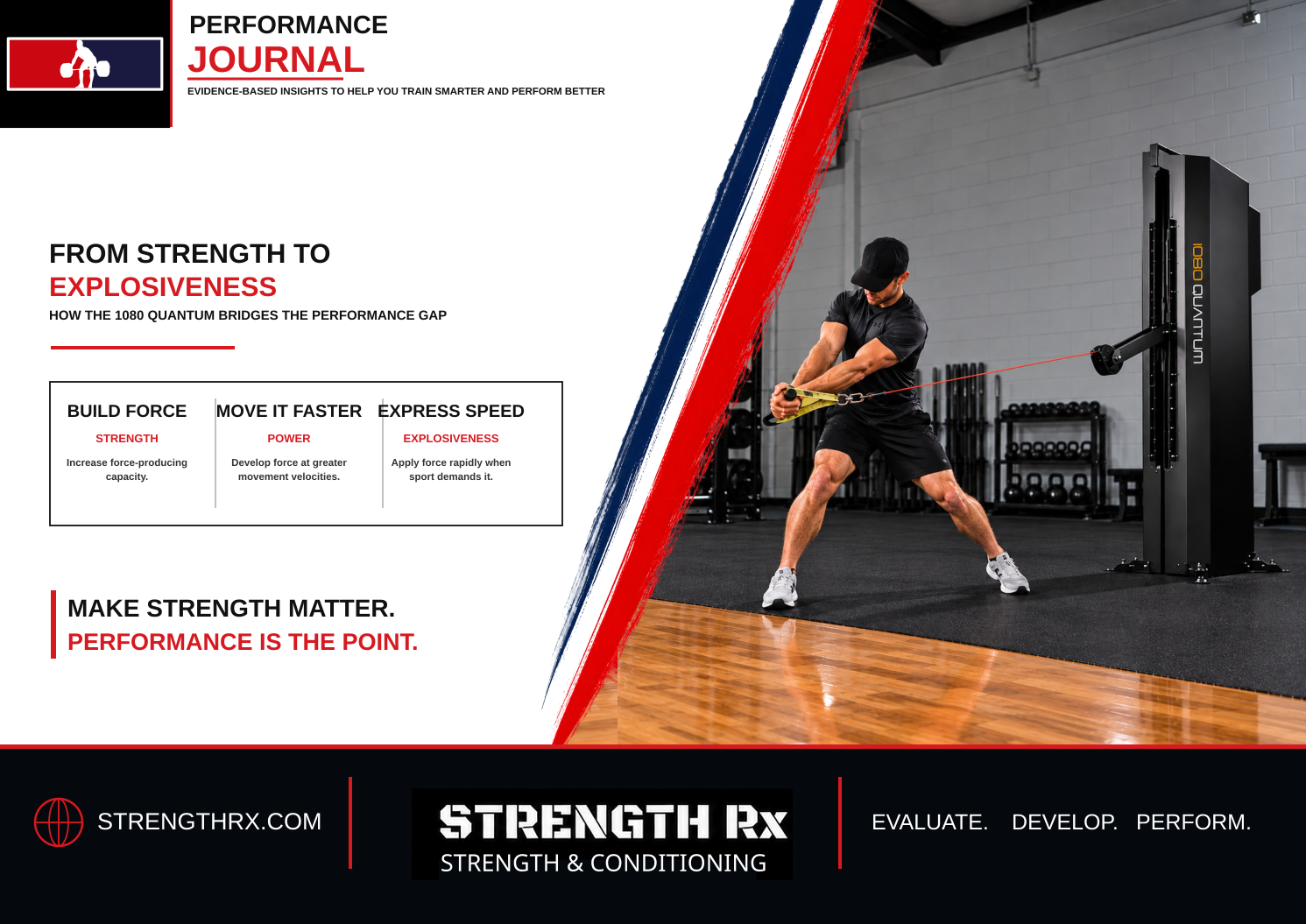
FROM STRENGTH TO EXPLOSIVENESS
How the 1080 Quantum Bridges the Performance Gap
Strength matters.
For athletes, however, simply becoming stronger is rarely the final objective.
Golfers don’t have several seconds to gradually produce force during a swing. A baseball player doesn’t have unlimited time to accelerate a bat. A tennis player must generate racket speed almost instantly. Hockey, lacrosse, throwing, striking, and other rotational sports present the same challenge.
The athlete has a limited amount of time to produce and transfer force.
That changes the question from:
How much force can you produce?
to:
How much force can you produce—and how quickly can you produce it?
That transition from force production to rapid force production is where strength begins to become explosiveness.
At Strength Rx, one of the tools we can use to train and objectively measure that transition is the 1080 Quantum™.
But the technology isn’t the program.
Understanding when, why, and how to apply resistance is what makes the technology useful.
STRENGTH IS THE FOUNDATION
Maximum strength represents an athlete’s ability to produce high levels of force.
That matters because an athlete cannot rapidly express force they don’t possess in the first place.
Traditional strength training therefore remains an important foundation of athletic development.
Squats, hinges, presses, pulls, unilateral exercises and other appropriately selected strength movements can increase the body’s ability to produce force.
But sporting movements typically occur much faster than a heavy strength exercise.
An athlete may have only fractions of a second to generate meaningful force.
This creates an important distinction between force capacity and the ability to express that force rapidly.
A stronger athlete has potentially increased the size of the engine.
Performance still depends on how effectively that engine can accelerate.
THE FORCE–VELOCITY CONTINUUM
Strength and speed aren’t separate qualities.
They exist along a continuum.
STRENGTH → STRENGTH-SPEED → SPEED-STRENGTH → SPEED
At one end, relatively heavy resistance produces high force but lower movement velocity.
As resistance decreases, movement velocity can increase.
Eventually, the emphasis shifts toward producing force extremely quickly against relatively small external resistance.
For athletic development, we often want exposure to different areas of this continuum rather than living exclusively at one end.
An athlete may need to improve:
- Maximum force production
- Force production at moderate velocities
- Rapid force development
- High-velocity power
- Movement speed
Which quality deserves the greatest emphasis depends on the athlete.
That is one reason simply trying to make every athlete “stronger” indefinitely can eventually become incomplete as a performance strategy.
Strength creates potential.
That potential still has to be converted into usable athletic output.
WHERE THE 1080 QUANTUM CHANGES THE TRAINING ENVIRONMENT
Traditional weights are excellent tools for developing strength.
But external load from a barbell, dumbbell or weight stack is largely determined by gravity and the mass being moved.
The 1080 Quantum™ gives us another option.
Its computer-controlled resistance allows us to precisely manipulate resistance during movement while collecting objective information about how the athlete performs against that resistance.
Instead of simply knowing how much weight was placed on a bar, we can examine variables associated with actual performance, including:
Force.
Velocity.
Power.
Acceleration.
Asymmetry.
We can also manipulate resistance differently depending on the objective of the exercise.
That creates opportunities to train across different portions of the force–velocity continuum while maintaining a high level of movement intent.
A movement can be relatively heavily resisted when the objective is greater force production.
Resistance can then be reduced as the objective shifts toward greater movement velocity.
At still lighter resistance, the emphasis can move toward rapid acceleration and explosive expression.
The exercise may look similar.
The physical quality being emphasized can be very different.
FROM STRENGTH TO EXPLOSIVENESS
Consider an athlete performing a rotational movement.
With greater resistance, the athlete must produce substantial force to initiate and continue the movement.
Reduce the resistance and movement velocity can increase.
Reduce it further and the athlete can attempt to accelerate through the movement as rapidly as possible.
The progression becomes:
BUILD FORCE
↓
PRODUCE FORCE FASTER
↓
INCREASE MOVEMENT VELOCITY
↓
EXPRESS FORCE EXPLOSIVELY
This allows resistance to become a variable rather than simply a number that must continually increase.
More resistance isn’t automatically better.
Less resistance isn’t automatically better either.
The correct resistance is the resistance that develops the physical quality we are trying to improve.
WHY THIS MATTERS FOR GOLF
Golf provides an excellent example.
The golf swing is an explosive rotational action occurring in a very short period of time.
Producing more clubhead speed isn’t simply a matter of trying to swing harder.
The golfer must produce force against the ground, coordinate movement through the lower body and trunk, transfer energy through the kinetic chain, and ultimately express that energy through the club.
Strength can contribute to that process.
But possessing strength and expressing it at golf-relevant speeds are not the same thing.
Using the 1080 Quantum, rotational movements can be resisted at different loads and velocities depending upon what we are attempting to develop.
A golfer who lacks force capacity may require one approach.
A strong golfer who struggles to express that strength rapidly may require another.
An athlete who already produces substantial force and power may need greater exposure to higher-velocity movement.
Those athletes shouldn’t automatically receive the same training simply because they all play golf.
The athlete determines the training—not the exercise or the machine.
BEYOND GOLF
The same principles extend to other rotational sports.
Baseball and softball hitters must rapidly accelerate the bat.
Throwers must produce and transfer force through the body before expressing it through the arm.
Tennis and pickleball players repeatedly accelerate the racket through multiple planes of movement.
Hockey and lacrosse athletes combine rotational power with skating, shooting, passing and rapid changes in direction.
Combat athletes must generate force rapidly through striking and rotational actions.
The sporting movements are different.
The underlying performance problem is similar:
Produce meaningful force within the time available.
That is why developing rotational athletes requires more than simply making them stronger.
The goal is to develop strength that can eventually be expressed at the speeds their sport demands.
MEASURE OUTPUT, NOT JUST EFFORT
One of the most valuable aspects of the 1080 Quantum is not resistance.
It is information.
Traditional training often tells us what an athlete completed:
Five repetitions.
A certain weight.
A certain number of sets.
Those numbers are useful, but they don’t necessarily tell us what the athlete actually produced.
Two athletes can perform the same exercise with the same resistance and appear to work equally hard while producing very different force, velocity and power characteristics.
The Quantum allows us to examine the output behind the movement.
That can help answer more useful questions.
Is velocity improving?
Is peak force changing?
Is power increasing?
Does output decline as resistance increases?
Are meaningful asymmetries present?
Is the athlete actually becoming more explosive—or does the exercise simply look explosive?
Effort matters. Output tells us what that effort produced.
TECHNOLOGY DOESN’T REPLACE COACHING
The presence of advanced technology does not automatically produce better training.
Data without context is simply data.
The 1080 Quantum does not replace traditional strength training.
It doesn’t replace coaching.
And it doesn’t turn every exercise into a better exercise simply because a computer is attached to it.
Its value comes from using it when the information or resistance characteristics can help answer a specific performance question.
Sometimes an athlete needs more strength.
Sometimes the athlete needs to produce existing strength faster.
Sometimes the athlete needs greater movement velocity.
Sometimes the limiting factor may lie somewhere else entirely.
The objective is not to make the athlete better at using the 1080.
The objective is to make the athlete better at their sport.
THE STRENGTH Rx APPROACH
At Strength Rx in Pleasant Hills, in the South Hills of Pittsburgh, we use the 1080 Quantum™ for strength, power and sports performance training, integrating the technology into an individualized training system rather than treating it as a standalone workout.
We can use traditional strength training to develop physical capacity and force production.
We can use the Quantum to apply precisely controlled resistance and examine force, velocity and power.
We can progressively move along the force–velocity continuum as the athlete’s needs change.
And we can use objective output to help determine whether the training is producing the adaptation we intended.
For golfers and other rotational athletes, that gives us another way to address the space between being strong and being able to express that strength explosively.
Because strength alone isn’t the finish line.
Neither is speed.
The goal is developing an athlete capable of producing the right amount of force, at the right velocity, within the time available for their sport.
The 1080 Quantum gives us an exceptional tool for training and measuring that process.
Knowing how to apply it is what makes it valuable.
PERFORMANCE IS THE POINT.
Alongside Strength Rx’s individualized coaching, Kinetic Torque™ uses the 1080 Motion platform to objectively measure and develop force production, rate of force development, speed, power, acceleration, deceleration, and movement efficiency in both linear and rotational performance.