
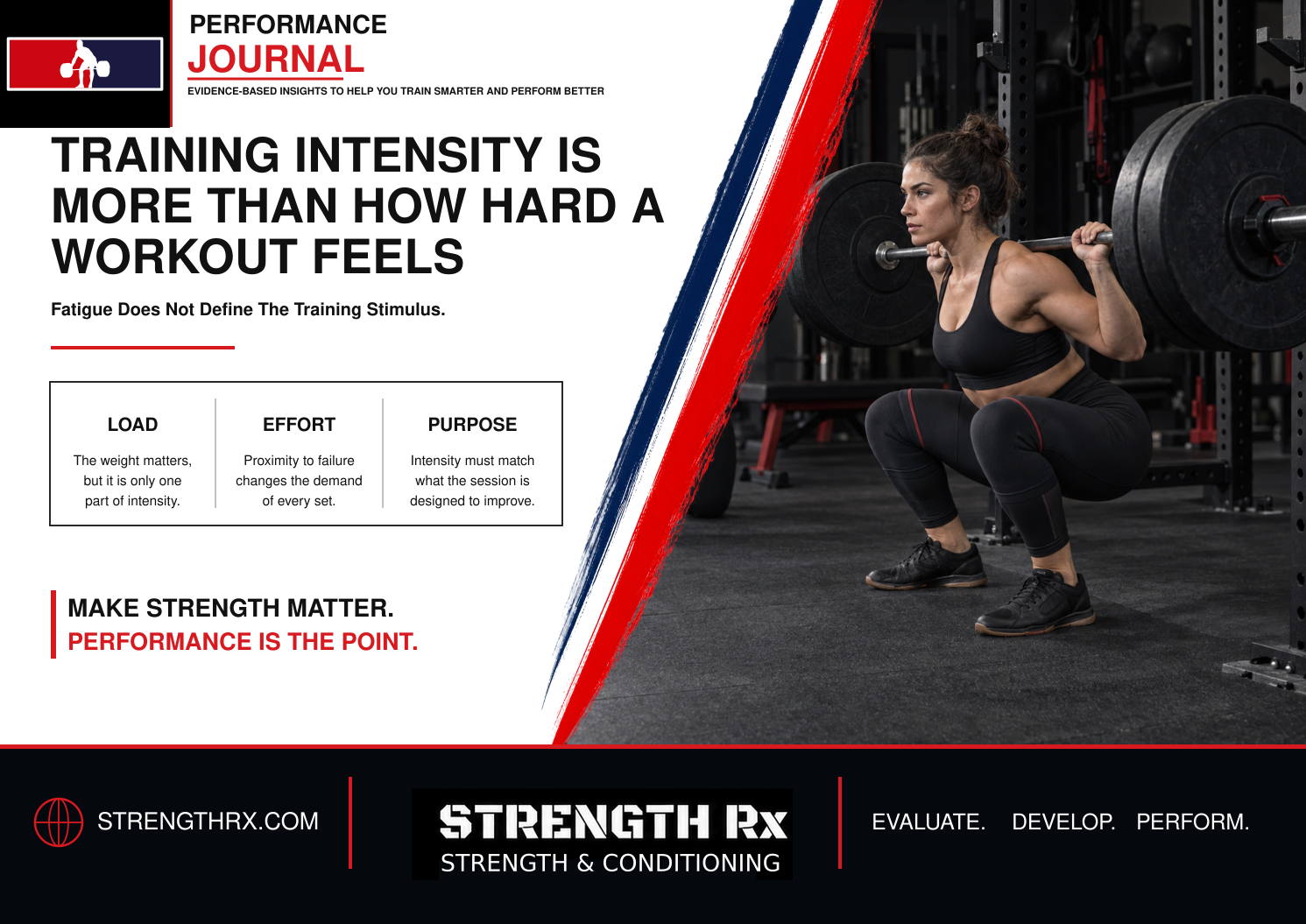
A demanding workout may feel intense, but fatigue alone does not tell you whether the training stimulus matched the goal.
People often describe training intensity by how exhausted they feel when a workout ends. Heavy breathing, burning muscles, sweat, and soreness are treated as evidence that the session was productive.
Those things tell us that the workout was demanding. They do not tell us exactly what was trained.
A session can feel extremely difficult without providing the right stimulus for strength, power, speed, muscle development, or physical capacity. Understanding intensity requires looking beyond discomfort and examining what the athlete or client was actually asked to produce.
What Training Intensity Actually Means
In strength training, intensity traditionally refers to the load being lifted relative to the maximum amount a person can lift for one repetition.
A squat performed with 85% of a one-repetition maximum is more intense—in terms of external load—than the same movement performed with 60%. This definition is useful, but it does not describe the entire training demand.
Intensity can also be influenced by:
- How close a set comes to muscular failure
- The speed and intent of each repetition
- The amount of rest between efforts
- The complexity of the exercise
- The total volume accumulated
- The athlete’s readiness on that day
The weight on the bar matters, but it is only one part of the picture.
Load and Effort Are Not the Same Thing
Two people can lift the same percentage of their maximum and experience very different levels of effort.
One athlete may complete five repetitions with several good repetitions still available. Another may struggle to finish the same set because of fatigue, poor recovery, stress, or differences in work capacity.
This is why relative effort matters.
Repetitions in reserve can help describe how close a set came to failure. A set completed with three repetitions remaining creates a different demand than a set taken to the point where another good repetition would not be possible.
Both sets may use the same weight. The training intensity experienced by the athlete is not necessarily the same.
This distinction allows training to be adjusted without abandoning the purpose of the program. The planned load provides direction, while the athlete’s performance helps determine whether that load is appropriate on a particular day.
Intent Changes the Stimulus
A moderate load moved with maximum intent can create a high-intensity neuromuscular demand without producing the same fatigue as a heavy or high-repetition set.
This is especially important when training power and speed.
The resistance must be sufficient to require meaningful force, but light enough to allow the athlete to move quickly. Every repetition should be performed with the intention of producing force as rapidly as possible.
Once movement speed drops substantially, the nature of the training begins to change. Continuing to perform slower repetitions may add fatigue, but it does not necessarily improve the quality the session was designed to develop.
For power training, intensity is not defined by exhaustion. It is defined by the quality and intent of the effort.
Rest Periods Affect Intensity
Rest is part of the training prescription.
Short rest periods increase cardiovascular and metabolic stress. They can make a workout feel harder even when the resistance is relatively light. This may be useful when the goal is conditioning, muscular endurance, or improving work capacity.
Strength, power, and speed training usually require more recovery between high-quality efforts. Longer rest allows force production and movement speed to recover before the next set.
Reducing rest simply to make the workout more difficult can change the intended adaptation.
If the goal is maximum force or power, beginning the next set while still fatigued may reduce output and turn a performance-based session into a conditioning session. The athlete worked hard, but the session may no longer be training the original quality.
Fatigue Is an Effect, Not the Objective
Fatigue is a normal result of training, but it should not automatically become the goal.
Adding repetitions, shortening rest periods, combining exercises, or extending a workout can make almost any session harder. The question is whether the added fatigue improves the desired adaptation.
More fatigue is not always more productive.
Excessive fatigue can reduce movement quality, limit force production, slow repetition speed, and interfere with recovery. It can also make it difficult to determine whether performance is improving because every session is evaluated by survival rather than measurable output.
A good training session creates enough stress to encourage adaptation without adding unnecessary work that compromises the next session.
Intensity Must Match the Goal
Different goals require different expressions of intensity.
Maximum strength requires exposure to heavier resistance, technically sound repetitions, and sufficient rest.
Power development requires high intent, appropriate resistance, fast movement, and stopping before output declines significantly.
Muscular development often requires greater total volume and sets performed relatively close to failure.
Work capacity may involve shorter rest periods, repeated efforts, and controlled fatigue.
Movement quality and return-to-performance training may require lower external loads while still demanding concentration, control, stability, and precision.
None of these approaches is universally better. Each becomes useful when it matches the goal and the needs of the person performing it.
The Hardest Workout Is Not Always the Best Workout
A well-designed program does not attempt to maximize every form of intensity at the same time.
Heavy loads, high volume, short rest periods, maximum movement speed, and repeated sets to failure cannot all be emphasized indefinitely. Trying to combine them often produces a great deal of fatigue without providing a clear training signal.
Productive training prioritizes the quality that matters most.
Some sessions should be heavy. Some should be fast. Some should accumulate volume. Some should restore movement and build capacity. The challenge is not making every workout as difficult as possible. It is applying the correct stress, in the correct amount, at the correct time.
How We Apply Intensity at Strength Rx
At Strength Rx, training intensity is selected according to the individual, the goal of the session, and the larger plan.
We consider more than the weight being used. We look at repetition quality, movement speed, effort, recovery, training history, injury history, and how performance changes throughout the session.
When appropriate, objective feedback helps us determine whether force, velocity, or power is being maintained. In other situations, movement quality and the number of good repetitions remaining provide the necessary information.
The purpose is not to make training easier. It is to make the difficulty productive.
The Takeaway
Training intensity cannot be judged by sweat, soreness, or exhaustion alone.
Load matters. Effort matters. Intent matters. Rest matters. The goal of the session matters.
A workout should be difficult enough to create the desired adaptation, but not so demanding that fatigue becomes the only measurable result.
The right question is not simply, “How hard was the workout?”
The better question is, “Did the intensity match what we were trying to improve?”
MAKE STRENGTH MATTER.
PERFORMANCE IS THE POINT.
Alongside Strength Rx’s individualized coaching, Kinetic Torque™ uses the 1080 Motion platform to objectively measure and develop force production, rate of force development, speed, power, acceleration, deceleration, and movement efficiency in both linear and rotational performance.