
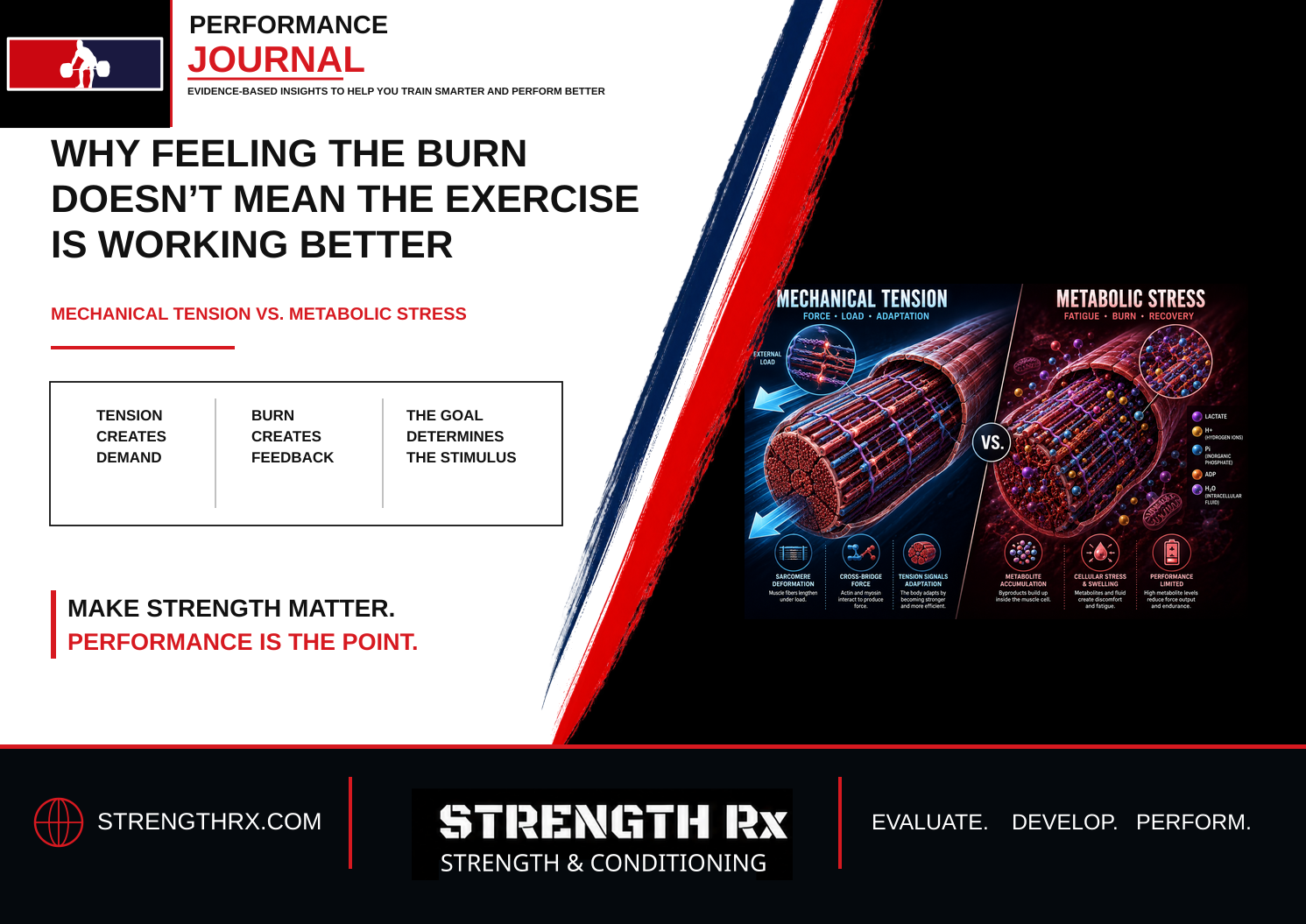
Mechanical Tension vs. Metabolic Stress
A hard set can burn.
Your muscles can feel completely exhausted. You can finish a workout drenched in sweat and barely able to perform another repetition.
None of those things necessarily tell you whether the training was effective.
They tell you the training was difficult.
There is a difference.
Exercise creates several forms of stress, and those stresses do not all produce the same adaptation. Two important factors are mechanical tension and metabolic stress. Both can play a role in training, but confusing one for the other can lead to judging exercises and workouts by how they feel rather than by what they actually accomplish.
The goal of training should not simply be to create fatigue.
The goal is to create the appropriate stimulus for the adaptation you are trying to produce.
Mechanical Tension: The Force the Muscle Has to Produce
Mechanical tension is created when muscle fibers produce force against resistance.
That resistance might come from a barbell, dumbbell, cable, machine, body weight, resistance device, or another external load. What matters is that the muscles involved must generate sufficient force to complete the task.
Mechanical tension can be influenced by several factors, including:
- External load
- Exercise selection
- Joint position
- Range of motion
- Muscle length
- Repetition speed
- Proximity to muscular failure
- The amount of force the athlete is attempting to produce
This is one reason simply looking at the weight on the bar does not tell us everything about an exercise.
A moderate load performed through a challenging range of motion may create substantial tension. Changing the tempo can alter how that tension is experienced. Performing a movement with greater intent can change force production even when the external resistance remains unchanged.
The training stimulus comes from the interaction of all of these variables—not from load alone.
Metabolic Stress: Why Muscles Burn
Metabolic stress is different.
During repeated muscular contractions, particularly when rest periods are short or sets continue for longer durations, metabolic byproducts accumulate within the working muscle.
That contributes to the familiar burning sensation experienced during higher-repetition or prolonged sets.
Muscles may feel swollen or pumped. Local fatigue increases. Continuing the set becomes increasingly uncomfortable.
That sensation is real.
But the intensity of the sensation does not provide a direct measurement of the quality of the training stimulus.
You can create an enormous amount of metabolic stress with relatively little force production.
That distinction matters.
The Burn Is Easy to Chase
One of the easiest ways to make training feel harder is to shorten the rest periods.
Perform more repetitions.
Add another exercise.
Use supersets.
Keep moving.
Reduce recovery.
All of these strategies can dramatically increase fatigue and metabolic stress.
They can also make a workout feel extremely productive.
But making training harder and making training more effective are not necessarily the same thing.
Consider strength or power development.
If recovery between sets becomes too short, force production begins to decline. Movement velocity decreases. Technique may deteriorate. The athlete may still be working extremely hard, but the quality we originally intended to train is disappearing.
At that point, the workout may have become very effective at producing fatigue while becoming less effective at developing the intended performance quality.
This is why rest between sets matters.
Recovery is not wasted training time. It is often what allows the next repetition or set to be performed at the level required to create the desired stimulus.
Fatigue Can Change the Exercise
An exercise does not exist independently of how it is performed.
Take a set of squats.
Five repetitions performed with a challenging load and adequate recovery place one type of demand on the body.
Fifteen repetitions performed with a lighter load create another.
The same fifteen repetitions performed immediately after another lower-body exercise create something different again.
The movement may still be called a squat.
The training stimulus is not necessarily the same.
Load, repetition range, tempo, rest periods, exercise order, and intent all influence what the body is being asked to adapt to.
This is why programming involves more than selecting exercises.
More Fatigue Can Mean Less Performance
For performance training, excessive fatigue can become particularly problematic.
Speed, acceleration, explosive strength, Rate of Force Development, and power all depend on the ability to produce force quickly.
As fatigue increases, that ability generally declines.
An athlete may continue performing repetitions, but if velocity and force production have fallen substantially, the nature of the training has changed.
This does not mean fatigue should always be avoided.
It means fatigue needs to have a reason.
There are times when developing work capacity or the ability to maintain performance under fatigue is appropriate. There are other times when the objective is maximum force, velocity, or power.
Those sessions should not look the same.
Metabolic Stress Isn’t Bad
The answer is not to eliminate metabolic stress.
It is simply another training variable.
Higher-repetition work can be useful for developing muscular capacity, increasing training volume, building muscle, or preparing someone to tolerate greater workloads.
For some goals, metabolic stress may be an intentional part of the program.
The problem begins when the sensation becomes the measurement.
A better workout is not automatically the one that creates the biggest pump.
A productive exercise does not need to burn.
And soreness the following day does not prove that the program worked.
Those are responses to training.
They are not the objective.
The Stimulus Has to Match the Goal
This brings us back to one of the most important principles in training: specificity.
The body adapts to the demands placed upon it.
If the goal is maximum strength, the program needs to provide an appropriate force demand.
If the goal is power, the athlete needs opportunities to produce force rapidly.
If the goal is speed, movement quality and velocity become critical.
If the goal is muscular capacity, longer sets and greater accumulated fatigue may become more appropriate.
If the goal is hypertrophy, sufficient mechanical tension combined with appropriate volume becomes important.
There is no single training sensation that tells us all of those things are happening.
The stimulus has to match the desired adaptation.
Stop Using Exhaustion as the Scorecard
There is nothing inherently wrong with finishing a difficult workout tired.
Some training sessions should be demanding.
But exhaustion should not become the standard by which every session is judged.
The better questions are:
What quality were we trying to develop?
Did the exercise create the appropriate demand?
Was enough resistance used to challenge that quality?
Was enough recovery provided to maintain the necessary output?
Can we progress or measure that quality over time?
Those questions tell us much more than whether the workout burned.
Good training is not about creating the greatest possible amount of discomfort.
It is about applying enough of the right stress to create the adaptation you actually want.
MAKE STRENGTH MATTER.
PERFORMANCE IS THE POINT.
Alongside Strength Rx’s individualized coaching, Kinetic Torque™ uses the 1080 Motion platform to objectively measure and develop force production, rate of force development, speed, power, acceleration, deceleration, and movement efficiency in both linear and rotational performance.