
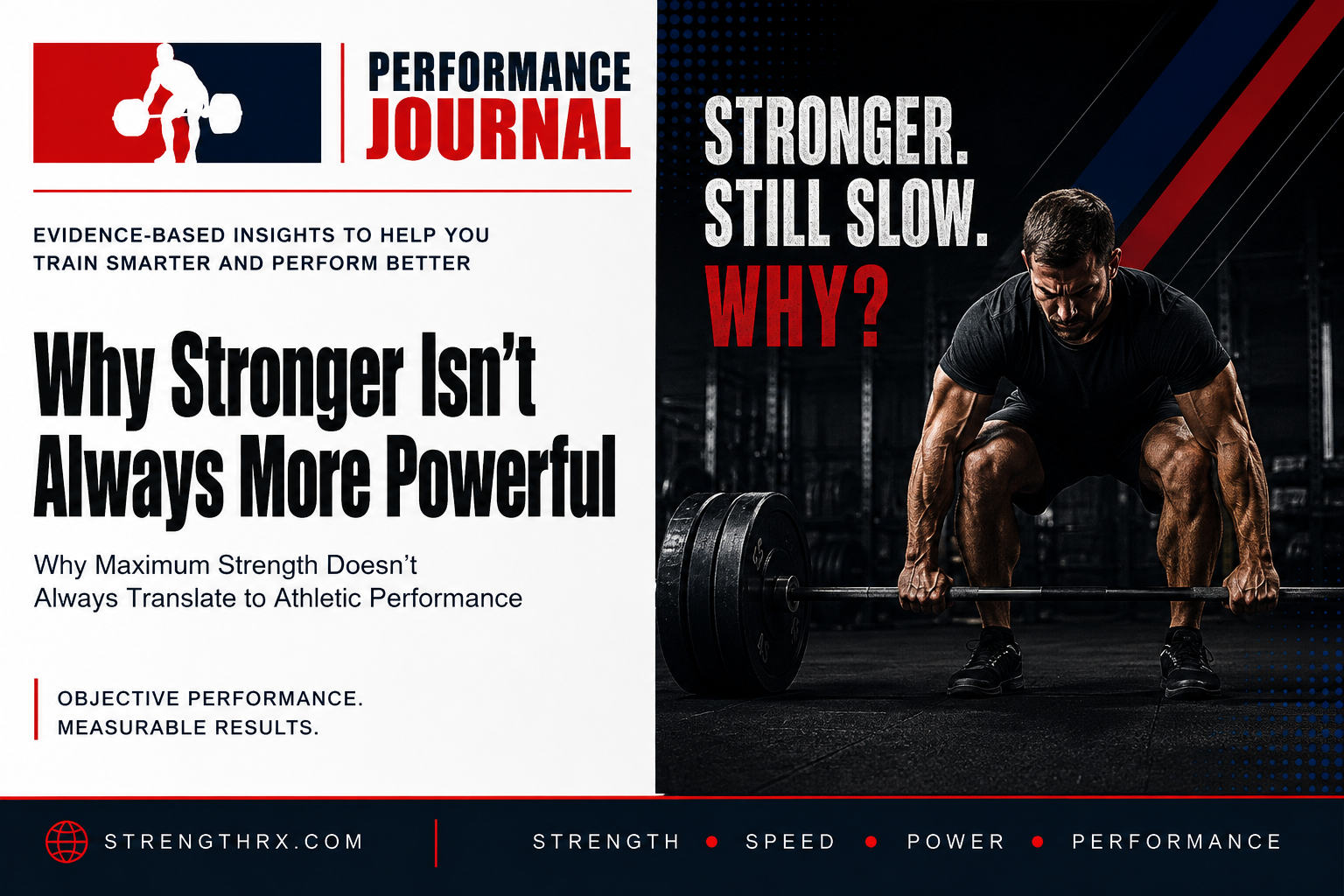
Building strength is one of the most effective ways to improve performance—but strength alone isn’t the finish line.
Many athletes and active adults assume that getting stronger automatically means they’ll run faster, jump higher, hit farther, or move more explosively. In reality, strength is only one part of the equation.
Power is what ultimately transfers to athletic performance.
Strength and Power Are Not the Same Thing
Although the terms are often used interchangeably, strength and power describe two different physical qualities.
Strength is your ability to produce force.
Power is your ability to produce force quickly.
A powerlifter moving a heavy barbell demonstrates tremendous strength.
A baseball player throwing a fastball, a golfer increasing clubhead speed, or an athlete accelerating out of the starting blocks demonstrates power.
Both require force.
Only one requires force produced rapidly.
Why Bigger Numbers in the Gym Don’t Always Transfer
Imagine two athletes with identical squat strength.
Both can squat 400 pounds.
One takes several seconds to produce that force.
The other can generate force almost instantly.
Who will accelerate faster?
Who will jump higher?
Who will hit the golf ball farther?
Almost always, the athlete who can create force more quickly.
Sport rarely gives you unlimited time to apply force.
Most athletic movements happen in fractions of a second.
If your body can’t express strength rapidly, much of your strength never becomes usable performance.
Force Plus Speed Equals Power
FORCE × VELOCITY = POWER
More Force + Same Speed = More Power
Same Force + More Speed = More Power
More Force + More Speed = Maximum Potential
Power depends on two things:
- The amount of force you can produce
- How quickly you can produce it
Improving either one can improve power.
Improving both creates the greatest potential.
This is why performance training eventually moves beyond simply lifting heavier weights.
The goal becomes producing high levels of force under increasing speed.
The Strength-Speed Continuum
Performance doesn’t exist in separate categories.
Instead, movement occurs across a continuum.
On one end is maximum strength.
As movement becomes faster, the emphasis gradually shifts toward speed.
Training can target different areas along that continuum depending on the demands of the athlete or activity.
Examples include:
- Maximum strength
- Strength-speed
- Speed-strength
- Maximum speed
Each serves a purpose.
An effective program develops the qualities that best transfer to the individual’s goals rather than training only one end of the spectrum.
Why Athletes Need More Than Strength
Consider several common performance tasks.
Sprinting
Ground contact lasts only a fraction of a second.
There isn’t enough time to “grind” force into the ground.
The athlete who creates force rapidly gains the advantage.
Golf
Clubhead speed depends on efficient force production, sequencing, and rotational speed.
Simply becoming stronger doesn’t guarantee increased distance.
The ability to transfer strength into fast rotational movement matters far more.
Jumping
A vertical jump isn’t determined by how much weight you can squat.
It’s determined by how effectively you can apply force before leaving the ground.
Again, time is limited.
Power wins.
More Strength Still Matters
None of this means strength isn’t important.
In fact, strength is the foundation upon which power is built.
Without adequate strength:
- Power potential is limited.
- Injury risk may increase.
- Force production has a lower ceiling.
Strength creates the potential to produce force.
Power is your ability to express that force quickly when performance demands it.
The strongest athlete isn’t always the most powerful.
The athlete who can apply force at the right time usually performs better.
Measuring More Than Weight on the Bar
Traditional training often measures progress by asking questions like:
- Did you lift more weight?
- Did you complete more repetitions?
- Did you train harder today?
Those are useful measurements.
But they don’t tell the whole story.
Performance improves when you also measure qualities such as:
- Force production
- Velocity
- Power
- Acceleration
- Deceleration
- Movement efficiency
These provide a much clearer picture of whether training is actually transferring beyond the gym.
The Bottom Line
Getting stronger is valuable.
But strength alone doesn’t guarantee better performance.
Athletes don’t compete by demonstrating how much force they can produce over several seconds.
They compete by producing the right amount of force at the right time, often in less than a second.
That’s why performance training shouldn’t stop with building strength.
It should teach your body to express that strength quickly, efficiently, and repeatedly in the movements that matter most.
Objective Performance. Measurable Results.
Alongside Strength Rx’s individualized coaching, Kinetic Torque™ uses the 1080 Motion platform to objectively measure and develop force production, rate of force development, speed, power, acceleration, deceleration, and movement efficiency in both linear and rotational performance.