
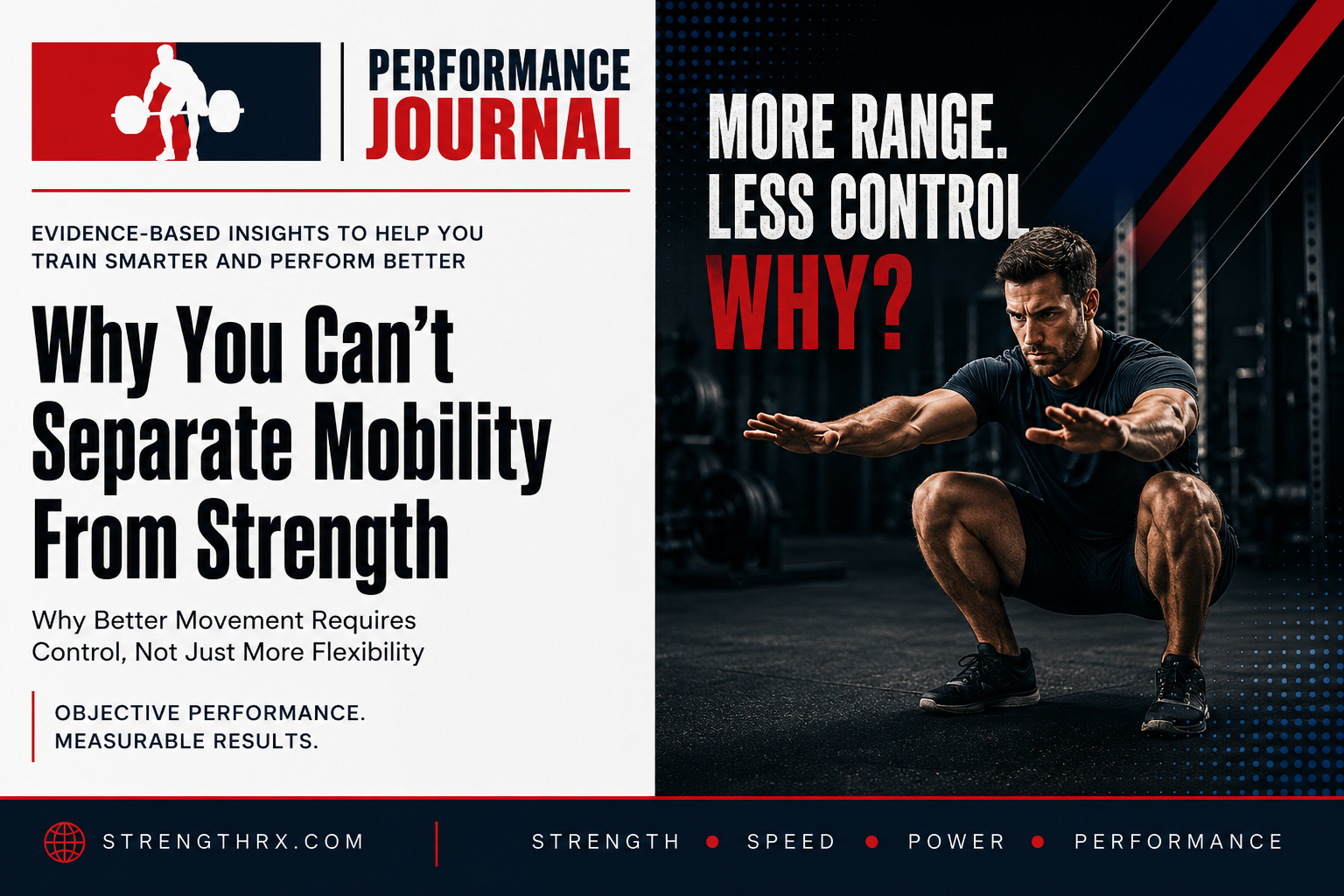
Most people think improving mobility means becoming more flexible.
Stretch more.
Loosen up.
Increase your range of motion.
While flexibility can be one component of mobility, it isn’t the whole picture—and for many people, it isn’t even the limiting factor.
Mobility isn’t simply how far a joint can move.
It’s whether you can actively control that movement.
That distinction changes everything.
Flexibility Is Passive. Mobility Is Active.
Flexibility describes the amount a muscle or connective tissue can lengthen.
Mobility describes your ability to actively move and control your body throughout that available range.
You may be able to pull your knee to your chest using your hands.
Can you lift it there under your own control?
You may be able to sit in a deep squat for a few seconds.
Can you produce force from that position?
Can you stabilize there?
Can you move out of it efficiently?
Those are mobility questions—not flexibility questions.
Your Brain Trusts What You Can Control
Your nervous system constantly evaluates movement.
If it senses instability, weakness, or poor control, it often limits available motion as a protective strategy.
Many people interpret this as being “tight.”
In reality, their body is protecting itself.
Improving mobility isn’t always about convincing muscles to lengthen.
Sometimes it’s about convincing your nervous system that the position is safe because you have the strength and coordination to own it.
Strength Creates Better Movement
Strength is often viewed as something separate from mobility.
In reality, they’re deeply connected.
When muscles become stronger throughout a full range of motion:
- Joint control improves.
- Stability increases.
- Coordination becomes more efficient.
- Confidence in movement grows.
As control improves, the body often allows greater movement without forcing additional stretching.
Strength doesn’t fight mobility.
It creates it.
Every Position Requires Strength
Every athletic position requires force production.
Landing from a jump.
Changing direction.
Rotating during a golf swing.
Accelerating into a sprint.
Reaching overhead.
Getting up from the floor.
None of these positions depend on flexibility alone.
They require the ability to stabilize, absorb force, and produce force throughout the entire movement.
That’s mobility.
Train the Position—Don’t Just Visit It
Many people spend time stretching into positions they never actually strengthen.
The result?
They temporarily gain range…
Then lose it.
Instead, train through the range you want to improve.
Squat deeper under control.
Press overhead with proper mechanics.
Build strength through gradually increasing ranges of motion.
Teach your body that the position is both available and useful.
The body adapts to what it repeatedly experiences.
Mobility Is Built, Not Borrowed
Stretching can temporarily change how a position feels.
Strength changes what your body can actually do.
The goal isn’t simply moving farther.
The goal is moving better.
When mobility and strength are developed together, movement becomes more efficient, more confident, and more resilient.
That’s the difference between reaching a position…
…and owning it.
Objective Performance. Measurable Results.
Performance isn’t determined by flexibility alone. At Strength Rx, we evaluate how well you move, how much control you have throughout that movement, and how effectively you produce and transfer force. Through individualized coaching, objective assessment, and purposeful programming, we develop movement quality that supports long-term performance—not just temporary improvements in range.
Every training decision is built around measurable progress. Whether you’re improving athletic performance, returning to higher-level activity, or simply moving better for everyday life, our focus is on developing movement you can control, strength you can use, and performance that lasts.
Alongside Strength Rx’s individualized coaching, Kinetic Torque™ uses the 1080 Motion platform to objectively measure and develop force production, rate of force development, speed, power, acceleration, deceleration, and movement efficiency in both linear and rotational performance.