
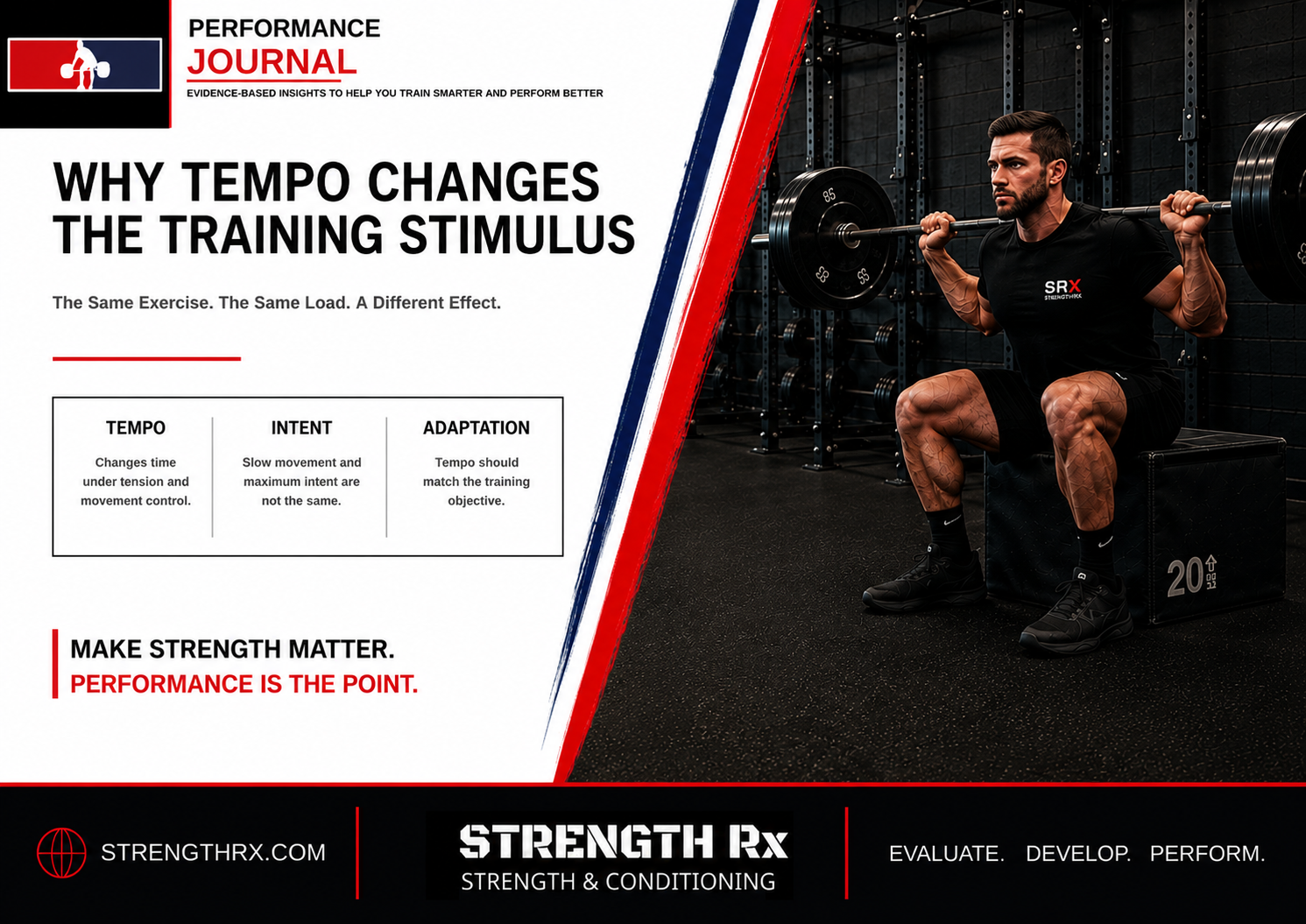
Two people can perform the same exercise with the same weight for the same number of repetitions—and create two very different training effects.
The difference can be tempo.
How quickly you lower a weight, whether you pause, how aggressively you attempt to accelerate it, and how long the muscles remain under tension all influence the demand placed on the body.
Repetitions are easy to count. Tempo helps determine what those repetitions actually mean.
Tempo Is More Than Moving Slowly
Tempo describes the speed and timing of the different phases of an exercise.
Consider a squat.
You can descend quickly, reverse direction immediately, and accelerate back to the top. Or you can lower for four seconds, pause at the bottom, and then stand.
The exercise hasn’t changed.
The load may not have changed.
The number of repetitions may not have changed.
But the training stimulus has.
Changing the timing of the movement changes how force must be produced, how long the muscles are exposed to tension, how much assistance comes from elastic energy, and how much control is required throughout the repetition.
That is why tempo should be considered a training variable—not simply a way to make an exercise harder.
The Eccentric Phase Matters
The eccentric phase occurs when a muscle produces force while lengthening.
In a squat, this happens primarily during the descent. In a bench press, it occurs as the bar is lowered toward the chest.
Slowing the eccentric portion of an exercise increases the amount of time the muscles must actively control the load.
That can be useful when the objective is to increase positional control, expose the body to longer periods of muscular tension, or develop strength through portions of a movement that might otherwise be rushed.
But a longer eccentric isn’t automatically better.
If the goal is maximum velocity, explosive performance, or the rapid expression of force, excessively slow movement can change the exercise enough that it no longer provides the intended stimulus.
The tempo needs to match the objective.
Pauses Change the Exercise Without Changing the Exercise
Adding a pause is another simple way to significantly alter the training demand.
Pause at the bottom of a squat and some of the elastic contribution normally available during the transition from lowering to lifting (the myotatic reflex, or stretch reflex) is reduced.
Pause a bench press on the chest and the athlete must produce force from a more static position.
Pause during an isometric position and the demand changes again.
The exercise still looks familiar, but the way force must be produced has changed.
This is one reason pauses can be valuable. They can remove momentum, expose weak positions, increase positional awareness, and require the body to generate force under different mechanical conditions.
The pause isn’t there simply to make the set uncomfortable.
It should have a purpose.
Intent Is Part of Tempo
Tempo doesn’t only refer to deliberately slowing something down.
The concentric—or lifting—phase is equally important.
When the objective is developing strength, power, or Rate of Force Development, the intent to move rapidly can matter even when the load itself moves slowly.
A heavy resistance may physically prevent high movement velocity. That doesn’t mean the athlete should intentionally move it slowly.
There is an important difference between:
moving slowly because you were instructed to move slowly
and
moving slowly despite attempting to accelerate as hard as possible.
Those are not the same stimulus.
One emphasizes controlled movement and time under tension.
The other demands high force production and aggressive neural intent against a resistance that limits actual velocity.
The bar may appear slow in both situations.
What the athlete is asking the body to do is completely different.
Time Under Tension Is a Tool, Not the Goal
Tempo is often discussed in terms of time under tension.
Time under tension simply describes how long the working muscles are exposed to force during a repetition or set.
Slower repetitions generally increase it.
That can be useful.
But more time under tension is not automatically more productive training.
Extending every repetition simply to make a muscle work longer can create additional fatigue without necessarily improving the quality you are trying to develop.
If the objective is control, muscular development, or increasing tolerance to a particular position, additional time under tension may be appropriate.
If the objective is speed or explosive force production, excessive time under tension may interfere with the quality of the work.
The question should never be:
How can we make this exercise harder?
The better question is:
What adaptation are we trying to create?
The Same Exercise Can Serve Different Purposes
This is one of the reasons exercise selection alone tells you very little about a training program.
A squat can be used to develop several different qualities depending on how it is loaded and performed.
A controlled eccentric squat with a pause creates one demand.
A heavy squat performed with maximum concentric intent creates another.
A lighter squat performed explosively creates another.
The movement may look similar, but the stimulus is not.
Load, velocity, range of motion, volume, rest periods, exercise selection, and tempo interact to determine what the body is actually being asked to adapt to.
Changing one variable can change the purpose of the exercise.
Tempo Should Match the Adaptation
There is no universally correct tempo.
There is only a tempo that is appropriate—or inappropriate—for the intended training effect.
Sometimes we want controlled movement.
Sometimes we want prolonged tension.
Sometimes we want to eliminate momentum.
Sometimes we want an athlete to hold a specific position.
And sometimes we want the exact opposite: move with as much intent and acceleration as possible.
Good programming doesn’t apply the same tempo to everything.
It manipulates tempo when changing the timing of the movement helps create the desired adaptation.
That is an important distinction because training should never become a collection of arbitrary ways to make exercises more difficult.
Difficulty isn’t the objective.
Adaptation is.
The human body responds to the demands placed upon it. Tempo is one of the variables that helps define exactly what those demands are.
Change the tempo, and you can change the stimulus.
Change the stimulus, and you can change the adaptation.
MAKE STRENGTH MATTER.
PERFORMANCE IS THE POINT.
Alongside Strength Rx’s individualized coaching, Kinetic Torque™ uses the 1080 Motion platform to objectively measure and develop force production, rate of force development, speed, power, acceleration, deceleration, and movement efficiency in both linear and rotational performance.