
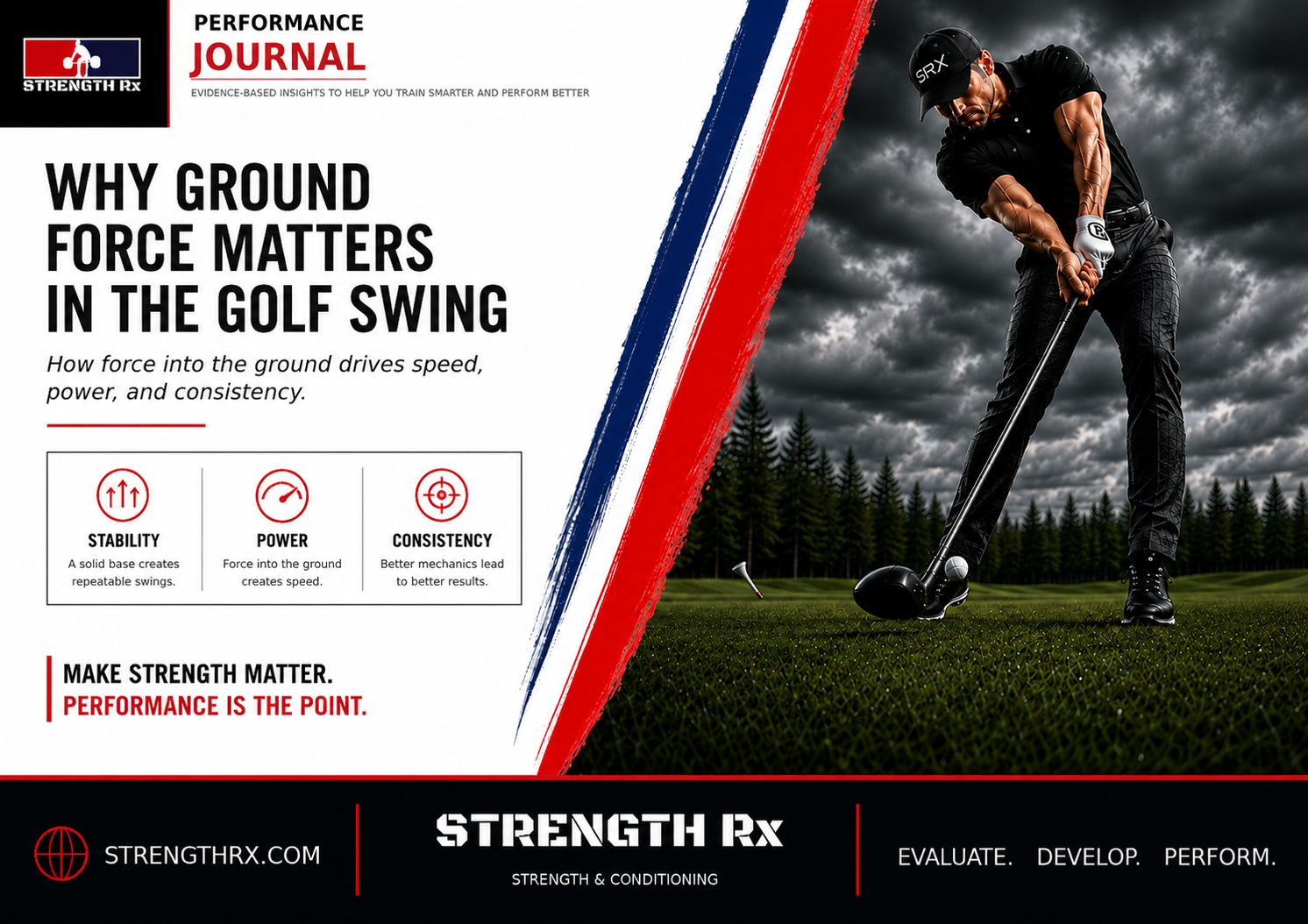
The Golf Swing Starts From the Ground Up
A golf swing may appear to be driven by the hands, arms, and club, but the production of force begins much earlier in the chain.
Before the club accelerates toward the ball, the golfer is interacting with the ground.
Every time you push into the ground, the ground pushes back. These forces—commonly referred to as ground reaction forces—provide part of the foundation from which the body can accelerate, rotate, and ultimately transfer energy through the club.
That does not mean more ground force automatically creates more clubhead speed.
It means that how much force you produce, how quickly you produce it, when you produce it, and how effectively you transfer it all matter.
The Ground Gives You Something to Push Against
The golf swing is a rotational movement, but rotation does not happen independently of the ground.
The feet interact with the ground while the lower body changes position, accepts force, redirects it, and contributes to the acceleration of the body.
Those interactions create forces that can be described in several directions, including vertical, horizontal, and rotational components.
The golfer isn’t simply trying to “push harder.”
The objective is to produce useful force at the appropriate time and in the appropriate direction.
That distinction matters.
Two golfers could potentially produce similar amounts of force against the ground yet use that force very differently during the swing. The final result depends on more than the magnitude of the force itself.
Force Has to Move Through the System
Producing force at the ground is only the beginning.
That force has to contribute to movement through the legs, hips, trunk, shoulders, arms, and eventually the club.
This is where physical capacity becomes important.
The lower body needs enough strength to produce and manage force. The trunk must be capable of transferring force while controlling position. The upper body must contribute without disrupting the sequence.
A limitation anywhere along that chain can change how force is expressed.
The body must be capable of supporting the speed you’re asking it to create.
How Fast You Produce Force Matters Too
Golf doesn’t provide unlimited time to develop force.
The swing happens quickly.
A golfer who is strong in a traditional strength exercise may have substantial force-producing capacity, but that does not automatically mean that force can be expressed rapidly enough to influence a high-speed athletic movement.
This is where Rate of Force Development becomes relevant.
Rate of Force Development describes how rapidly force can be produced. As movement becomes faster, the available time to generate useful force becomes increasingly important.
For golf performance, the question therefore isn’t simply:
How strong are you?
It also becomes:
How quickly can you access that strength?
Strength Still Matters
None of this makes traditional strength less important.
Maximum strength provides part of the physical foundation from which faster force production can be developed.
But strength is a capacity—not the final performance outcome.
As a golfer develops sufficient strength, training can progressively include demands that require force to be produced at higher velocities and within shorter periods of time.
That progression moves training along the continuum from:
Strength → Strength-Speed → Speed-Strength → Speed
The objective isn’t to abandon strength.
It is to develop the ability to use it under increasingly sport-relevant time constraints.
More Force Isn’t Automatically Better
This is where discussions about ground reaction force can become misleading.
Seeing a larger force number doesn’t automatically mean a golfer has improved.
Force must occur at the right time, in a useful direction, and as part of an effective movement strategy.
Producing tremendous force too late in the swing may provide little benefit. Producing force in a direction that doesn’t contribute effectively to the movement may not improve the outcome either.
And attempting to artificially reproduce force patterns seen in another golfer ignores differences in strength, mobility, body structure, technique, and individual movement strategy.
The goal isn’t to chase somebody else’s force trace.
The goal is to develop the physical qualities that allow your own movement strategy to become more effective.
Physical Training and Golf Instruction Are Not the Same Thing
Understanding ground force also helps establish an important distinction.
A golf professional works with the golf swing.
Performance training develops the physical qualities that allow the golfer to better produce and tolerate the forces associated with that swing.
Those roles can complement one another without becoming the same thing.
At Strength Rx and Kinetic Torque, the objective isn’t to teach someone how to swing a golf club.
It is to develop and measure qualities such as strength, force production, power, speed, acceleration, and the ability to express those qualities under increasingly specific demands.
The golfer then brings that increased physical capacity back to the golf swing.
The Golf Ball Only Sees the Result
Ultimately, the ball doesn’t know how much you squat, deadlift, or press.
It doesn’t know what exercises you performed.
And it doesn’t know how hard the workout felt.
It responds to what happens at impact.
The purpose of physical preparation is therefore not simply to make a golfer stronger. It is to develop physical qualities that can contribute to greater speed, control, durability, and performance when they are expressed through the golf swing.
Ground force is one part of that system.
An important part—but still only one part.
MAKE STRENGTH MATTER.
PERFORMANCE IS THE POINT.
Kinetic Torque develops the physical qualities behind rotational performance with one objective: building physical capacity that can transfer to performance.
Alongside Strength Rx’s individualized coaching, Kinetic Torque™ uses the 1080 Motion platform to objectively measure and develop force production, rate of force development, speed, power, acceleration, deceleration, and movement efficiency in both linear and rotational performance.