
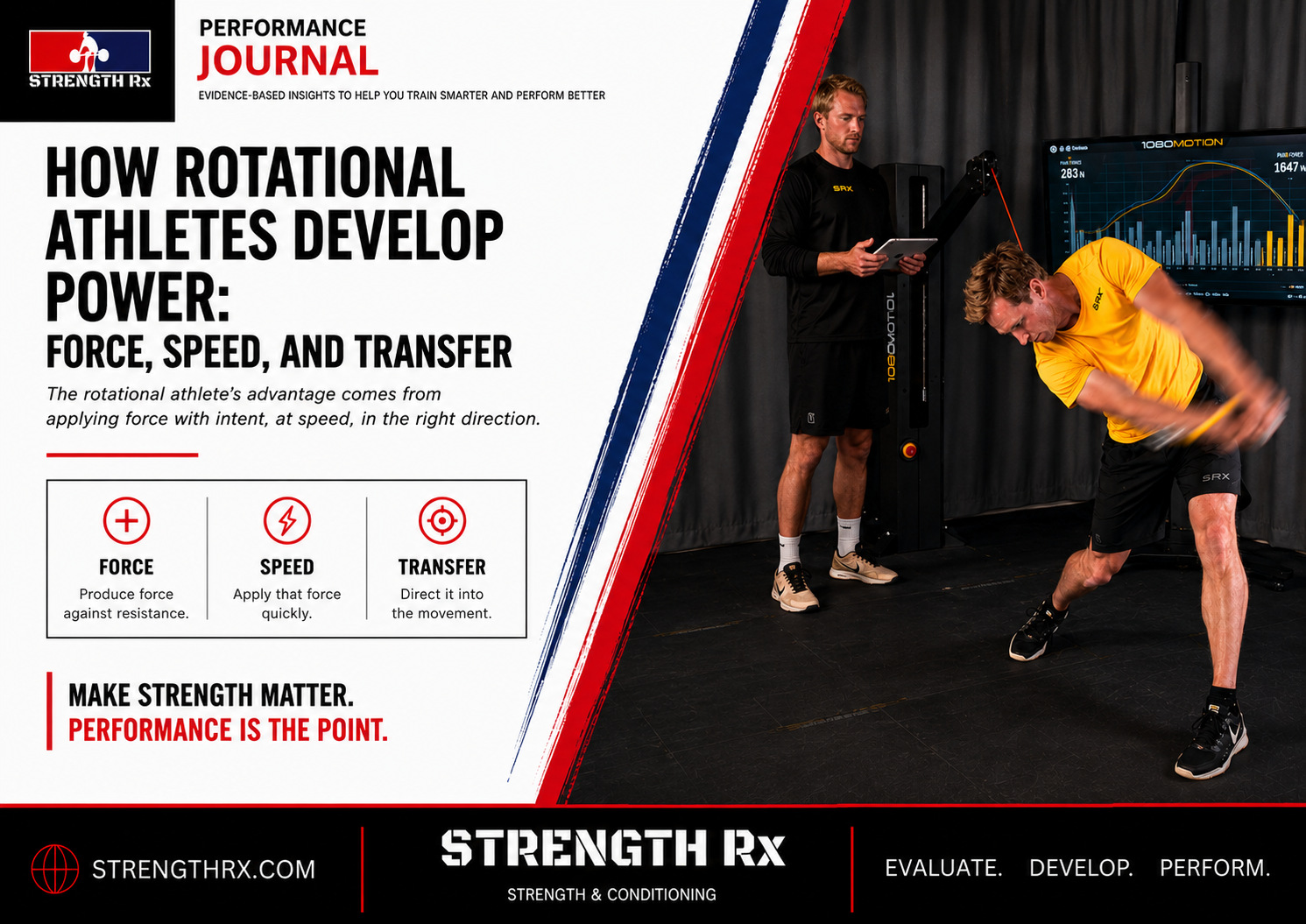
A golf swing. A baseball swing. A tennis forehand. A hockey shot.
They look different. They require different technical skills. They use different implements and take place under very different competitive demands.
But underneath those differences is a similar physical challenge.
The athlete has to produce force, produce it quickly, transfer it through the body, and ultimately express it at high velocity through a club, bat, racquet, or stick.
That is why developing rotational power requires more than simply performing more rotational exercises.
The implement changes. The physical problem does not.
Rotational Power Starts Before Rotation
It is easy to look at a golf swing or baseball swing and focus on what is happening around the trunk.
But rotational power does not begin there.
The athlete interacts with the ground first. Force produced through the lower body contributes to the movement of the pelvis and trunk before that energy is transferred toward the implement.
The exact sequence and technical demands differ between sports, but the underlying principle remains: the athlete needs sufficient physical capacity to create and transfer force.
That means rotational performance depends on more than rotational strength.
It depends on qualities such as:
- Force production
- Rate of Force Development
- Movement velocity
- Acceleration
- Coordination and sequencing
- The ability to transfer force efficiently
Improving one quality while ignoring the others can limit the final result.
A stronger athlete is not automatically a more powerful athlete. And an athlete who can move quickly without producing sufficient force may face a different limitation.
The objective is not simply to become stronger or faster.
It is to develop the appropriate combination of physical qualities for the task.
Strength and Power Are Not the Same Thing
Strength provides an athlete with the capacity to produce force.
That capacity matters.
But rotational sports rarely give an athlete unlimited time to use it.
A golfer cannot take several seconds to produce force during the downswing. A hitter has a brief window to accelerate the bat. A tennis player must respond to a moving ball. A hockey player may have only an instant to create and release a shot.
This is where Rate of Force Development becomes important.
The question changes from:
How much force can you produce?
to:
How much force can you produce in the time available?
That distinction is central to athletic power.
An athlete may become significantly stronger without seeing an equivalent improvement in swing speed, bat speed, racquet speed, or other high-velocity movements.
Strength matters.
But strength has to become usable.
The Force-Velocity Continuum
Power development is often treated as though it were one type of training.
It isn’t.
Different combinations of force and velocity create different training demands.
A useful way to think about this is as a continuum:
Strength → Strength-Speed → Speed-Strength → Speed
At one end, resistance is relatively high and movement velocity is lower.
As we move across the continuum, resistance generally decreases while movement velocity increases.
None of these qualities exists completely independently of the others. The training emphasis simply changes.
This matters because an athlete’s limiting factor may not always be the same.
One athlete may need greater force-producing capacity.
Another may already be strong but need to express that force more quickly.
Another may need greater movement velocity.
That is why simply prescribing more resistance—or simply telling an athlete to move faster—does not automatically solve the problem.
The training stimulus should reflect the adaptation we are trying to create.
Power is the result of how force and velocity come together.
Maximum Intent Does Not Mean Maximum Resistance
Explosive training should involve intent.
But maximum intent does not mean using the greatest resistance possible.
If the objective is maximum force development, the training demand should reflect that objective.
If the objective shifts toward strength-speed, speed-strength, or maximum movement velocity, the resistance and movement demands should change with it.
The athlete may still be working with maximum intent.
What changes is the environment in which that intent is expressed.
This is one reason specificity matters so much in performance training.
The body adapts specifically to the demands placed upon it.
Changing resistance changes the problem the athlete has to solve.
Changing velocity changes the problem.
Changing the time available to produce force changes the problem.
Effective power development means deliberately manipulating those demands rather than labeling every fast-looking exercise as “power training.”
Where the 1080 Quantum Fits
This is where technology can expand what is possible in training.
At Strength Rx and Kinetic Torque, the 1080 Quantum gives us another way to manipulate resistance, velocity, and movement demands while objectively measuring what the athlete produces.
That distinction is important.
The value of the 1080 is not simply that it provides resistance.
There are plenty of ways to provide resistance.
Its value is the control it gives us over the training stimulus and the information it provides about the athlete’s response.
Depending on the objective, we can change the resistance and movement demands to place greater emphasis on different portions of the force-velocity continuum.
Greater resistance can shift the emphasis toward force production.
Different loading conditions can challenge the athlete where force and velocity must coexist.
Lower resistance can allow movement to occur at substantially higher velocities when speed becomes the priority.
The exercise may look similar.
The stimulus can be very different.
That gives us the ability to train toward specific qualities rather than simply asking an athlete to perform a generic “explosive” movement.
Measuring What the Athlete Actually Produces
There is another important difference.
We can measure output.
Force.
Velocity.
Power.
Acceleration.
Asymmetry.
Changes across repetitions and training sessions.
Without objective information, it is easy to judge an exercise by appearance.
A movement may look fast.
A set may feel difficult.
An athlete may believe a repetition was explosive.
Those observations have value, but they do not tell us everything about what actually happened.
Objective data gives us another layer of information.
It helps answer better questions.
Did velocity increase?
Did the athlete produce more force?
Did power improve?
Did one side behave differently from the other?
Did adding resistance improve the intended quality, or did it slow the movement enough to change the training stimulus?
That information can help guide the next decision.
Most training measures effort. Kinetic Torque measures output.
Golf: Producing Speed Through the Club
Golf provides an obvious example of rotational power.
The objective is not simply to make the golfer stronger.
Strength can increase the available capacity.
Rate of Force Development influences how quickly that capacity becomes available.
Speed-oriented training helps the athlete learn to express force at higher velocities.
The goal is not to replace golf instruction.
It is to develop the physical qualities the golfer can bring to the swing.
Build the golfer. The golf ball responds.
Baseball and Softball: Force Has to Become Bat Speed
The same basic principles appear in hitting.
A hitter needs sufficient force-producing capacity, but the competitive task occurs quickly.
There is limited time to generate and transfer force before the bat reaches the ball.
Simply becoming stronger does not guarantee greater bat speed.
The athlete must be capable of expressing that strength rapidly and transferring it through a coordinated rotational movement.
Training can therefore move across different portions of the force-velocity continuum depending on what the athlete needs.
The goal is not to teach hitting mechanics.
It is to give the hitter greater physical capacity to express through those mechanics.
Tennis, Pickleball, and Racquet Sports
Racquet sports add another challenge.
The athlete does not always operate from the same stance or position.
Movement may occur laterally, forward, backward, or while recovering from the previous shot.
The athlete has to organize force quickly and transfer it into the racquet while responding to an external stimulus.
Strength matters.
Speed matters.
Rapid force production matters.
And the ability to express those qualities from different positions matters.
Once again, the technical stroke belongs to the sport.
Our role is to develop the physical qualities available to the athlete performing it.
Hockey, Lacrosse, and Other Rotational Sports
A hockey shot or lacrosse shot looks different from a golf swing or baseball swing, but many of the underlying performance questions remain.
How much force can the athlete produce?
How quickly can it be produced?
How effectively can that force move through the body?
How much velocity can ultimately be expressed through the stick?
Different sports require different technical solutions.
That does not mean the physical qualities underneath them are completely different.
This is why rotational performance training should not be built around copying the sporting movement in the weight room.
The goal is to identify and develop the qualities that support it.
Training the Athlete Without Trying to Coach the Sport
This distinction is important.
Kinetic Torque is not designed to replace a golf professional, baseball hitting coach, tennis professional, hockey coach, or another sport-specific instructor.
Technical skill matters enormously.
But technical coaching and physical development are not the same thing.
A sport coach develops the skill.
Our job is to help develop the athlete who has to perform that skill.
That means improving the physical qualities that influence how much force, speed, and power the athlete has available.
The two should complement one another rather than compete with one another.
Build the Athlete. The Implement Responds.
A club.
A bat.
A racquet.
A hockey stick.
The implement may change, but it ultimately reflects what the athlete is capable of producing and transferring into it.
That is the broader purpose behind Kinetic Torque.
We are not trying to make every athlete train the same way simply because their sports involve rotation.
We are identifying the qualities that influence performance, determining where the athlete currently stands, and applying training demands intended to improve those qualities.
The 1080 Quantum expands our ability to do that by allowing us to manipulate resistance and velocity while objectively measuring the resulting output.
But the technology is still only a tool.
The objective remains the same:
Apply the right stimulus. Measure the response. Make a better decision about what comes next.
Because rotational power is not simply about rotating harder.
It is about developing force, expressing it quickly, and transferring it into performance.
Build the Athlete. Measure What Matters.
At Strength Rx and Kinetic Torque, performance training is built around the individual athlete and the demands of the activity they want to improve.
Golf, baseball, softball, tennis, pickleball, hockey, lacrosse, and other rotational sports may require different skills, but each depends on an athlete capable of producing and transferring force at the speed the sport demands.
By combining individualized training with objective performance technology such as the 1080 Quantum, we can evaluate force, velocity, power, acceleration, and other performance qualities and use that information to guide how training progresses.
The objective is not to chase numbers simply because they can be measured.
It is to use measurement to make better training decisions—and develop physical qualities that have the potential to transfer where they matter.
MAKE STRENGTH MATTER.
PERFORMANCE IS THE POINT.
Alongside Strength Rx’s individualized coaching, Kinetic Torque™ uses the 1080 Motion platform to objectively measure and develop force production, rate of force development, speed, power, acceleration, deceleration, and movement efficiency in both linear and rotational performance.